




BLOG
Which Way Should My Ceiling Fan Turn in the Summer?
Most ceiling fans have a direction switch that gets flipped once and forgotten. If yours is set wrong for summer, it's working against you. Ceiling fan direction in summer is a two-minute fix that can show up on your electric bill all season.
The Quick Answer: Counterclockwise in Summer
In summer, your ceiling fan should spin counterclockwise when you look up at it from below. That downward airflow creates a wind-chill effect that can make a room feel up to 4°F cooler, which means you can raise your thermostat and trim cooling costs without losing comfort. Remember that fans cool people, not rooms. Turn them off when you leave. A fan running in an empty room just wastes energy.
How to Tell Which Way Your Fan Is Spinning
The easiest way to tell which way a ceiling fan is spinning is to stand directly underneath it on high and feel for airflow. A strong downward breeze on your skin means it's set correctly for summer.
If you barely feel anything, or the air seems to be moving up and around the edges of the room rather than down at you, it's likely running clockwise (the winter setting).
Modern fans with a remote, wall control, or smart app may display the current direction on a screen or indicator light. Check the manual if you're unsure.
How to Change Your Ceiling Fan's Direction
The whole process takes about two minutes. Here's how:
- Turn the fan off. Wait for the blades to come to a complete stop before touching anything.
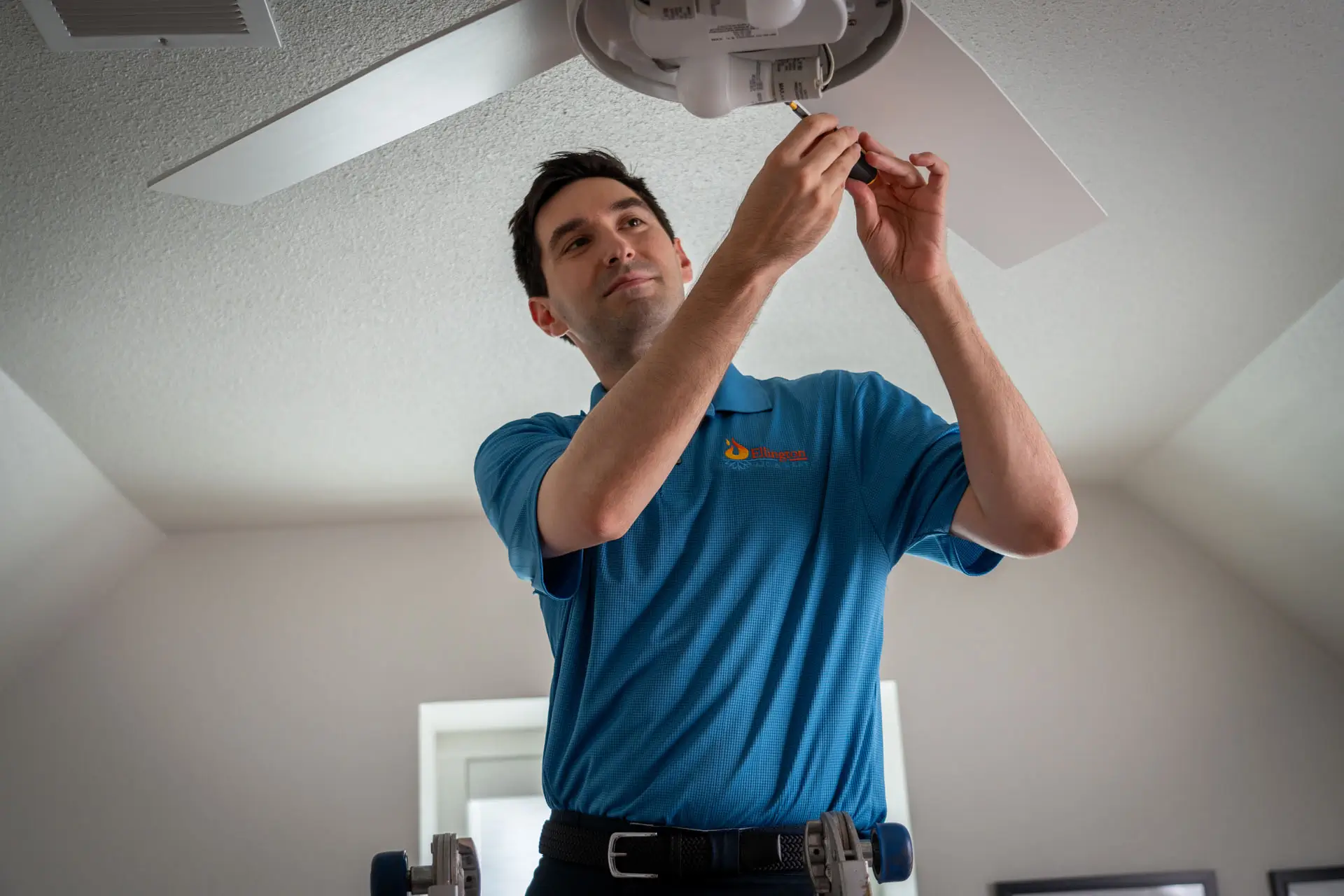
- Find the ceiling fan direction switch. It's a small toggle on the side of the motor housing, the cylindrical part the blades attach to, usually just below the canopy. It'll say "Summer / Winter" or have a forward/reverse label.
- Flip the switch. If your fan has a remote or smart app, look for a "reverse ceiling fan" button or direction control instead.
- Restart the fan on high. Let it run for a few seconds.
- Stand underneath and confirm. You should feel a direct downward breeze. If not, the switch didn't engage fully. Try toggling it again.
Use a stable step stool to reach the motor housing safely. Never reach toward the blades while the fan is running. Once confirmed, a counterclockwise ceiling fan on medium or high is doing exactly what it should.
Summer vs. Winter Fan Direction
Ceiling fans have two settings, and most homeowners only think to check once and forget about it. Fan direction in winter vs. summer is a simple toggle, but the difference in how your home feels is real. This table shows the breakdown at a glance.
| Season | Direction (viewed from below) | Blade Effect | Speed | Why It Helps |
|---|---|---|---|---|
| Summer | Counterclockwise | Pushes air straight down | Medium to high | Wind-chill effect makes skin feel up to 4°F cooler |
| Winter | Clockwise | Pulls air up, pushes warm air down along walls | Low | Redistributes heat that collects near the ceiling |
A ceiling fan should spin counterclockwise in summer and clockwise in winter. Counterclockwise on a higher speed drives a cooling downdraft. Clockwise on low speed in winter gently lifts air and pushes trapped warm air down along the walls. Most fans have a small reverse switch on the motor housing to change direction.
The winter setting only helps if you run it on low. High speed in clockwise direction creates a downdraft anyway and defeats the purpose. As a rule of thumb, switch to clockwise when you turn the heat on in the fall and back to counterclockwise when cooling season starts again.
Why Fan Direction Matters More on the Space Coast
On Florida's Space Coast, the efficiency argument for ceiling fans is stronger than most places. Homes in Rockledge, Edgewater, Sebastian, and Satellite Beach run their air conditioning for 10 to 11 months out of the year.
In a northern climate, a small efficiency gain from fan use adds up over a few summer months. Here, that gain compounds across nearly the entire calendar.
The U.S. Department of Energy puts the thermostat payoff at about 4°F. Raise it that much with a ceiling fan running and most people don't feel the difference. The DOE also estimates each degree you raise your thermostat cuts cooling costs by roughly 3–5%. On a long Space Coast summer, that adds up.
One caveat worth knowing here: a fan won't lower your home's humidity, and Brevard and Volusia counties run at 75 to 80 percent relative humidity through most of the summer. Your AC still needs to run to pull moisture out of the air. The efficiency benefit comes from using both together: keeping the fan on so you can set the thermostat a few degrees higher, not from cutting AC use entirely. If your AC needs a tune-up before summer gets serious, AC maintenance is a good place to start.
Need Help With Your Ceiling Fan? Call Ellington.
If your fan is wobbling, wired wrong, in need of replacement, or you want to add a new one to a room that doesn't have one, Ellington AC & Electric handles ceiling fan installation and electrical repair throughout the Space Coast: Rockledge, Edgewater, Sebastian, Satellite Beach, and the surrounding communities in Brevard, Volusia, and Indian River counties.
For homes with smart thermostats or whole-home controls, home automation options can let you manage fan direction, speed, and scheduling automatically.
Call (321) 222-0605 or schedule online to book a visit.
Schedule Online
Frequently Asked Questions
Which way should a ceiling fan turn in the summer?
Counterclockwise, viewed from below. This creates a downward airflow that produces a wind-chill effect on your skin, making the room feel cooler without actually lowering the temperature.
How do I know if my fan is spinning the right way?
Turn it on high and stand directly underneath it. A strong downward breeze means it's set correctly for summer. If you feel little airflow or notice air circulating around the edges of the room rather than toward you, it's running in the winter (clockwise) setting.
Do ceiling fans really save money?
The savings are real but indirect. A ceiling fan doesn't lower room temperature. It creates a wind-chill effect that lets you feel comfortable at a higher thermostat setting. The Department of Energy puts that comfort window at about 4°F. On the Space Coast, where cooling runs most of the year across homes in Rockledge, Edgewater, Sebastian, and Satellite Beach, that adjustment adds up over a long, humid summer.
Should I leave my ceiling fan on all the time?
No. Fans cool people through airflow across the skin, so a fan running in an empty room does nothing useful and just runs up your electric bill. Turn fans off when you leave the room.
Why isn't my ceiling fan keeping me cool even on high?
A few things can cause this. The direction might be set to clockwise (the winter setting), which creates an updraft rather than a downdraft. The fan might be wobbling, which disrupts consistent airflow. It could also be undersized for the room. A smaller fan won't move enough air in a large open living space. And if your ceilings are above 9 or 10 feet without a downrod extension bringing the fan lower, the airflow may not reach you effectively. If the fan seems to be running but not moving much air, or if it's wobbling or making noise, an electrical repair visit can diagnose the issue.